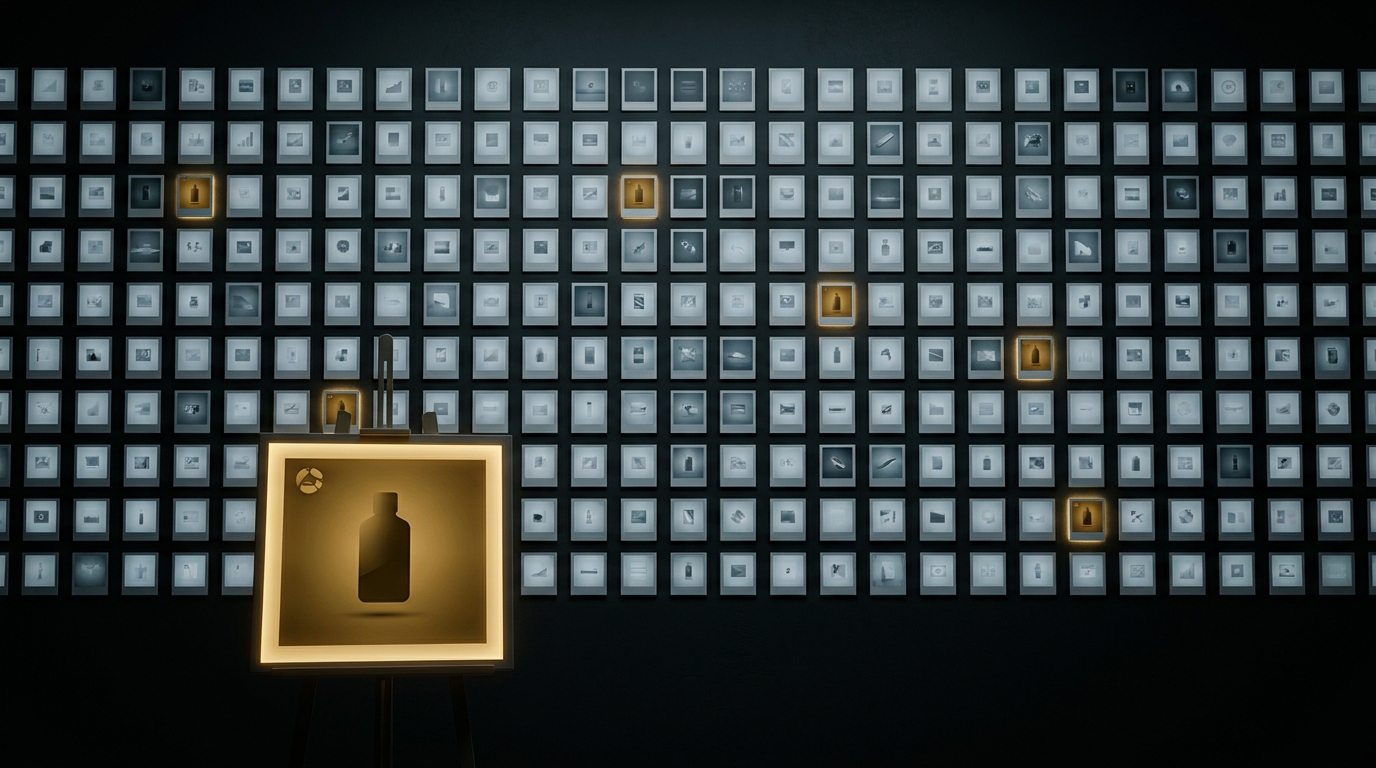
The short version: A funded podcast-recording SaaS was producing fewer than 10 ad variants a month at $500 to $2,000 each. We moved production onto our AI performance creative pipeline. Output rose to 40+ variants a month at $60 to $190 all in, cost per variant fell roughly 80%, and CAC in the newest market dropped from $34 to $2.59.
Two numbers do the work in that summary: cost per variant and CAC. The rest of this teardown explains how one drove the other, and how much of it transfers to a different account.
This teardown explains how that happened. The client is a funded podcast-recording SaaS scaling user acquisition across five international markets. We anonymize clients on this blog, so no name, but every number below comes from the account.
The work used the pipeline behind our AI performance creative service. Here is the before state, what we changed, the after numbers, and which parts of the result you should expect on your own account.
What did creative production look like before?
Before the switch, the team sourced ad creative from creators and freelance editors. Each finished variant cost $500 to $2,000 and took 5 to 10 days to deliver. Output topped out below 10 variants a month, so testing was rationed and losing ads stayed live for weeks.
That output ceiling was the real problem, more than the invoice. Entering a new market means testing messaging angles until one converts. At fewer than 10 variants a month, finding a winner in one market can take quarters. This client wanted five markets at once.
The cost showed up in the acquisition math. CAC in untested markets sat at $34 or higher, largely because the account was running old creative while new concepts sat in a production queue.
What did we change in the creative pipeline?
We replaced creator sourcing with an AI production pipeline under human creative direction. It has four parts: a brief taxonomy that maps audience segments to messaging angles, an image and video model stack that generates the assets, a human filter that reviews every variant, and channel-native formatting for each placement.
The brief taxonomy came first. Before generating anything, we mapped the client’s segments across all five markets and defined the angles worth testing: ease of use, audio quality, remote collaboration. Each market got its own visual treatment. Every variant produced afterward was tied to one specific hypothesis from that map.
The model stack did the production. An image model generates the still or the avatar, a video model animates it, and a batching layer queues the renders so nobody watches a progress bar. The tool-by-tool detail is in our workflow post; the short version is that production stopped being the bottleneck.
The human filter stayed. A creative director wrote the angles and reviewed every generated variant before it shipped. When we have skipped that step on other tests, the output drifts generic. The pipeline is cheap because production is automated, not because judgment is.
Everything shipped channel-native. Static ads, 9x16 video hooks, and carousel formats, each built for its placement rather than resized from a master file. Landing page variants were produced in the same sprints so the test extended past the click.
What were the after numbers?
Cost per variant fell roughly 80%, from $500 to $2,000 creator-shot to $60 to $190 all in. Monthly output rose from fewer than 10 variants to 40+ across five markets. Production time per variant dropped from 5 to 10 days to under an hour of human time.
| Metric | Before | After |
|---|---|---|
| Cost per finished variant | $500 to $2,000 | $60 to $190 all in |
| Variants produced per month | Fewer than 10 | 40+ |
| Production time per variant | 5 to 10 days | Under an hour of human time |
| CAC in the newest market | $34+ | $2.59 |
| CTR on top variants | Baseline | 3x improvement |
The business results followed the volume. Subscriptions rose 25% from March to June against the prior period, from 5.6K to 7K. Conversion rate came in 20% better than the client’s previous PPC campaign.
Want this math run on your account?
Our AI performance creative engagements start with your current cost per variant and testing cadence, then model the gap.
Book a Free Strategy CallWhere does the 80% number come from?
The 80% figure compares the full cost of a creator-shot variant against the full cost of an AI-pipeline variant, human time included. It is a conservative read. Midpoint to midpoint, the ranges imply a drop closer to 90%. We publish the lower number because we count every hour, not only the tool spend.
The creator side is not padded. According to Influencer Marketing Hub’s TikTok rate benchmark, nano-to-mid tier creators charge $200 to $1,250 per branded video before any production overhead. Add shipping, brief loops, editing, and revisions and the finished variant lands at $500 to $2,000.
The AI side is $8 to $40 in raw tool cost per variant, plus the human time for direction and review. Managed as an agency engagement, that works out to $60 to $190 all in. The full line-item breakdown is in our cost post; this account tracked those ranges.
Did cheaper variants lower CAC?
Yes, and volume did the work, not the unit price by itself. Cheap variants matter because they buy testing shots. At 40+ variants a month, the account found winning angles in weeks instead of quarters, and the winners pulled CAC from $34 to $2.59 in the newest market.
Paid social rewards that cadence. According to TikTok’s creative best-practices guidance, advertisers should use diversified creatives and refresh them when performance declines. At creator-shot prices, that advice is expensive. At AI-pipeline prices, it becomes the default operating rhythm.
One caveat. Creative was the core engine on this account, but it did not run alone. We also handled paid media buying across Meta, Google, and TikTok, SEO content, and conversion tests on the homepage and pricing page. The 92% CAC drop belongs to that full stack, with creative volume as its largest input.
What generalizes, and what was specific to this client?
The cost math travels. The $500 to $2,000 creator range and the $60 to $190 pipeline range are market-wide 2026 figures, not artifacts of this account. So does the velocity gain: any team running this pipeline can produce variants in hours and refresh creative weekly. The volume-finds-winners pattern holds on every paid social account we have run it on.
The exact CAC result does not generalize, and we would not pitch it as if it did. That $2.59 came from a new, low-competition market, a product with a broad creator audience, and a full-stack engagement running media, SEO, and CRO together. On a mature account in a crowded auction, expect the cost-per-variant drop and the velocity gain first, then a CAC improvement whose size depends on your market.
Two companion pieces carry the detail this teardown compresses: the full cost breakdown with every line item, and the workflow post showing the pipeline tool by tool.
If your creative budget is buying fewer than 10 variants a month, Book a Free Strategy Call and we will show you what it should be buying instead.
Seeing patterns like this in your own growth data?
We help growth-stage companies diagnose exactly what's working and what's not.
Book a Free Strategy Call